

CTT designs, manufactures, and characterises advanced frequency selective devices for the terahertz region of the spectrum ranging from 30 GHz to 30 THz. Our unique technology offers unparalleled performance, precision and durability.
Superiority Engineered for the most exacting requirements.
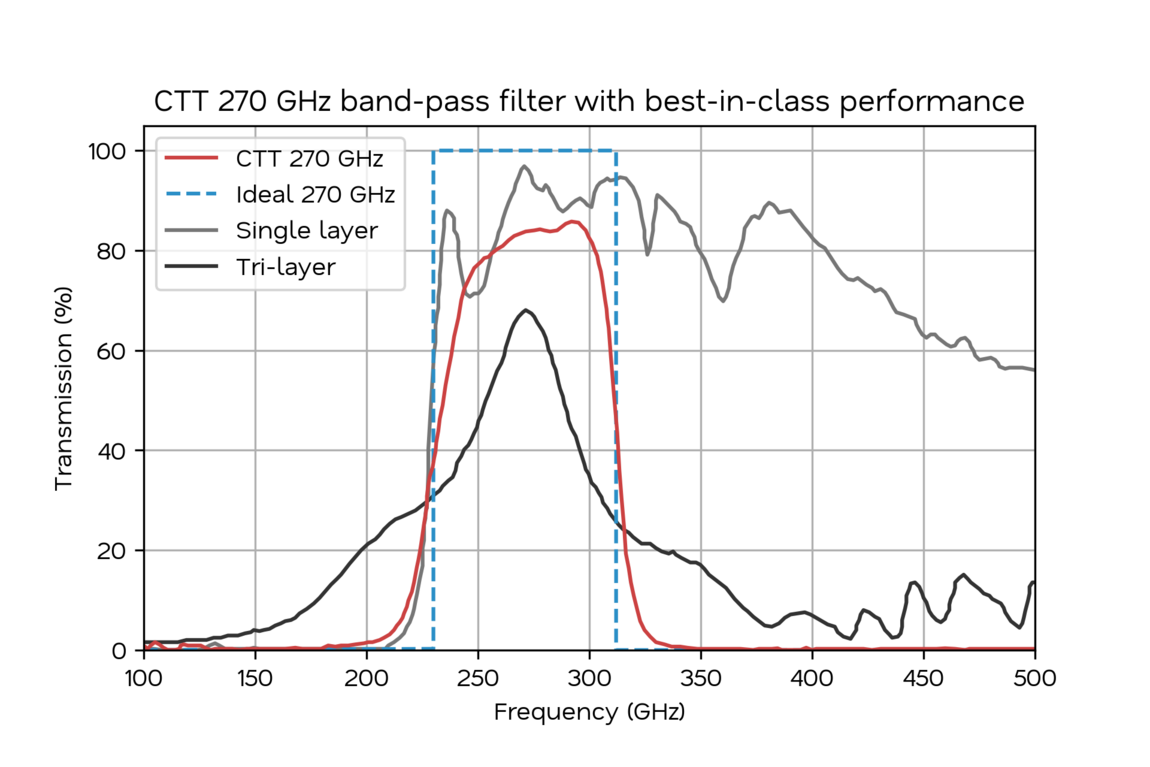
CTT filters offer low in-band loss and extremely high out-of-band blocking over a wide frequency range. The plot to the right depicts this top-level requirement and indicates how our technology compares with other solutions.
Out-of-band rejection is dominated by reflection to ensure minimal thermal loading of cryogenic platforms.
We offer a bespoke design consultancy service for every circumstance, from single devices to complex multi-element receiver filtering schemes.
Performance On the lab bench. In the cryostat. In space.
State of the art astronomy demands high performance detectors, good enough to measure the change in power that would result if we could strike a match on the surface of the Sun!
To achieve the desired level of sensitivity, detectors are typically cooled to sub-Kelvin temperatures (below -272 C). Exposure to radiative power must be limited to a precisely specified range of frequencies.
High performance filters are therefore critical. They must transmit the tiny in-band signal power efficiently to the detectors. At the same time they must block unwanted power to a very high level.
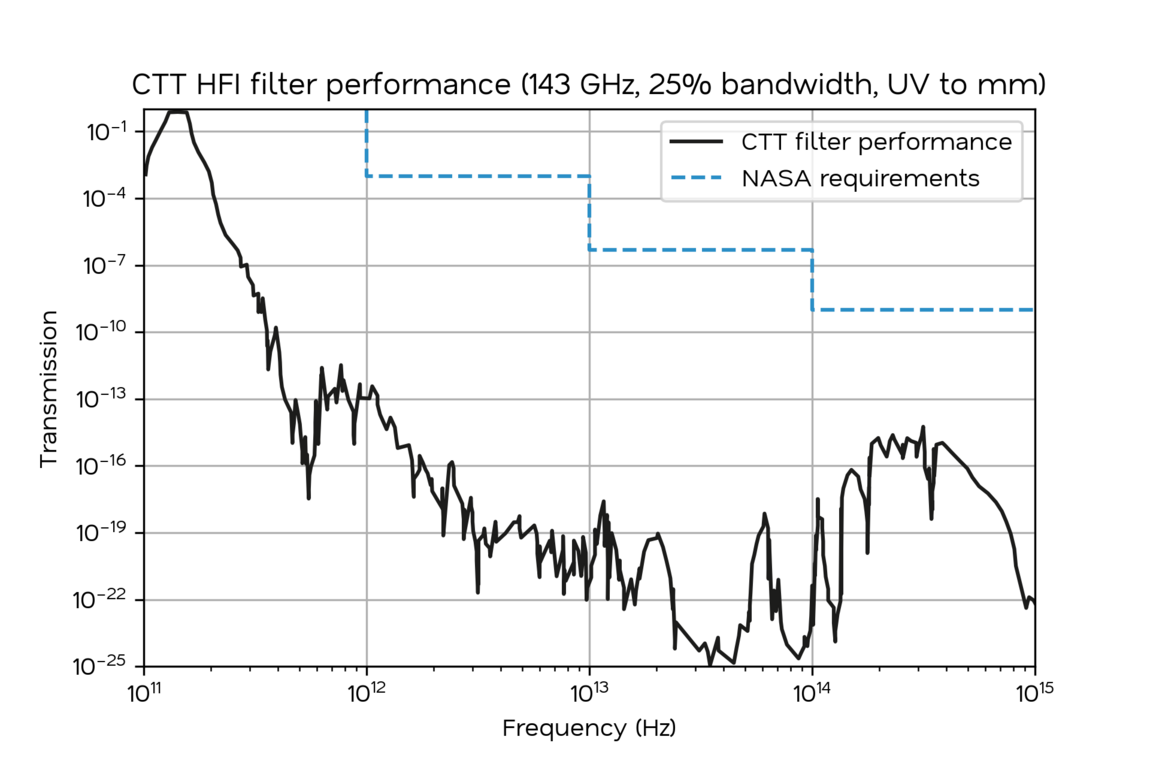
The plot on the left shows the spectral blocking specification for the HFI instrument on ESA's Planck Space Observatory. Our filters achieved more than was specified by orders of magnitude, reducing cryogen consumption. The lifetime of the Planck mission was thus extended by 14 months.
Impact Tailored solutions for the most demanding applications.
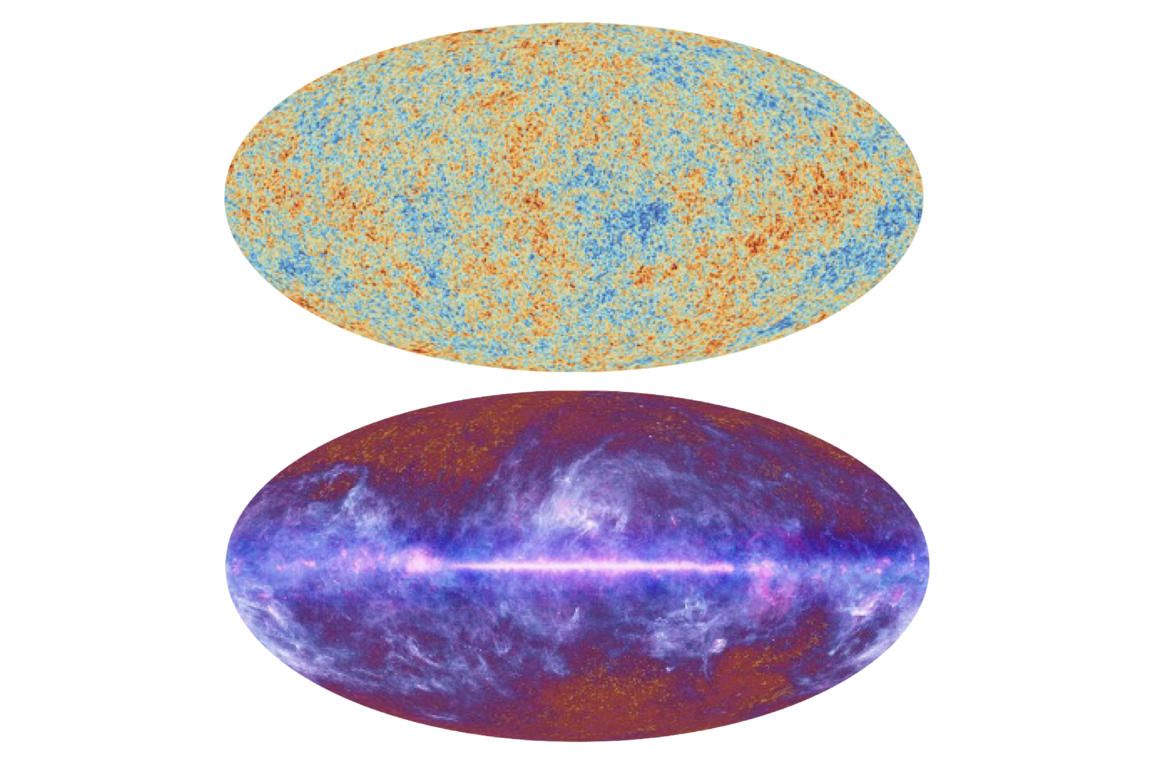
“In March 2014 the European Space Agency confirmed a standard theory in modern cosmology known as inflation. Congratulations to them - and to the human race.“
Wall Street Journal
Leader Comment – Sunday Nov 14th 2014
Reaction to results from the Planck Space Observatory.